A gentle guide to the Pomodoro Technique
How the Pomodoro Technique works, how long a session should be, and how to handle interruptions and breaks without turning focus into pressure.
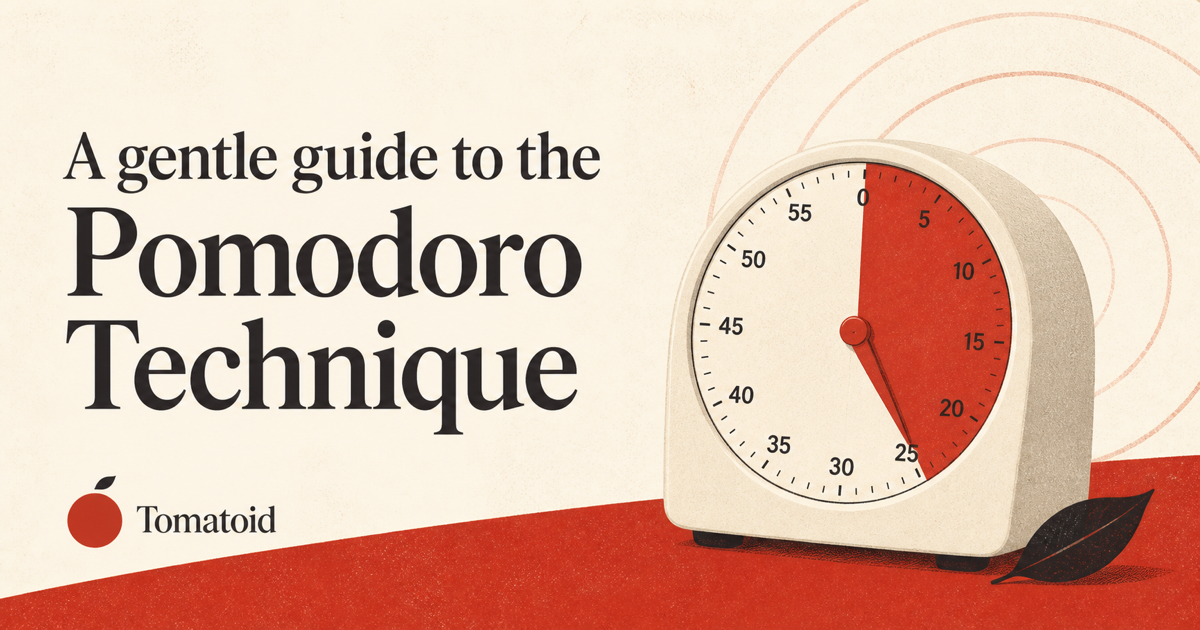
The Pomodoro Technique is a small agreement with yourself: choose one thing, give it your full attention for a bounded stretch of time, then stop and take a break. The timer is not there to hurry you. It is there to make the edge of the work visible.
A focus timer can be a source of pressure, or it can be a quiet container. The useful version helps you begin, protects you from interruptions, and gives you permission to rest.
The technique in one minute
Francesco Cirillo developed the method in the late 1980s as a university student, timing his study sessions with a tomato-shaped kitchen timer. Pomodoro is Italian for tomato, and a single focus session is still called a pomodoro.
The classic rhythm is straightforward:
- Choose one clear intention for the session.
- Focus for 25 minutes.
- When the timer ends, record the session and take a 5-minute break.
- After four focus sessions, take a longer 15-minute break.
You do not need a perfect task list before you start. “Draft the opening paragraph” is enough. So is “Read the next section” or “Make the first sketch.” A useful intention is specific enough to guide you and small enough not to become a planning project of its own.
25 minutesClassicStart the classic timerWhy a timer can make starting easier
Open-ended work carries a hidden question: how long will this take? A timer replaces that question with a smaller one: can I stay with this until the bell? You are not promising to finish everything. You are promising to return your attention to one place for a known amount of time.
That boundary also makes stopping easier. When the session ends, you can look at what changed, leave a short note for your future self, and step away without having to decide whether you have “done enough.”
Choose a rhythm that fits the work
Twenty-five minutes is a good default because it is long enough to settle in and short enough to feel approachable. It is not a law. Different kinds of work have different entry costs.
- 15 minutes can help when you feel stuck, tired, or intimidated by the first step.
- 25 minutes works well for everyday writing, reading, admin, and study.
- 50 minutes gives complex work more room before the interruption of a break.
- 90 minutes suits work that benefits from a long runway, provided you can protect the time and take a meaningful break afterward.
Longer sessions earn longer breaks. Tomatoid pairs 50 minutes of focus with a 10-minute break and 90 minutes with 20, so recovery grows with the effort.
If you repeatedly reach the end just as the work becomes absorbing, try a longer preset. If you postpone starting because the session feels too large, make it smaller. The best interval is the one you will begin and can recover from.
What to do with interruptions
Some interruptions arrive from the room around you. Others arrive from inside your own head: send that email, look up that reference, remember to buy something, check one harmless notification.
When a person interrupts, a quick “Can I get back to you in fifteen minutes?” usually works. Most requests can wait until the timer ends, and the ones that cannot are worth stopping for.
Thoughts are harder to wave away, and trying not to think about them often gives them more energy. Write the thought down instead, without leaving the session. In Tomatoid, Park a thought does exactly that. Press I or tap the button, note the distraction, and return to your intention. Parked thoughts wait in History, where you can copy them into whatever list you already use once the session is over.
This keeps each session about one intention without pretending the rest of life has disappeared.
Make breaks genuinely different
A break works best when it changes your physical or mental state. Stand up. Look into the distance. Drink water. Open a window. Let your eyes and hands do something other than the work you just paused.
Scrolling can feel like a break because it is different content, but it often keeps the same posture, the same screen, and the same rapid attention shifts. There is no need to make breaks virtuous; just give your attention a real change of scene.
Tomatoid never starts a break automatically. When the timer reaches zero, you can start the suggested break, finish the session, add five minutes, or keep counting up. That small pause keeps the rhythm responsive to the work instead of letting the clock decide for you.
A gentle first session
If you want to try the technique now, keep the setup deliberately small:
- Close or silence what you can.
- Write one intention in plain language.
- Start with 25 minutes, or 15 if beginning feels heavy.
- Park distractions instead of following them.
- At zero, notice what changed before choosing what comes next.
You can customize durations, sounds, and focus spaces later. None of that is required. One intention and one press of the start button are enough.
25 minutesClassicBegin one gentle session